- Published
- Reading time
- 13 min
- Tags
Transcendent Cause
The sun reflected off the waves. The sand looked like baby powder. Another near-perfect 83-degree day, with a gentle breeze softening the heat and tall palm trees bent slightly to…
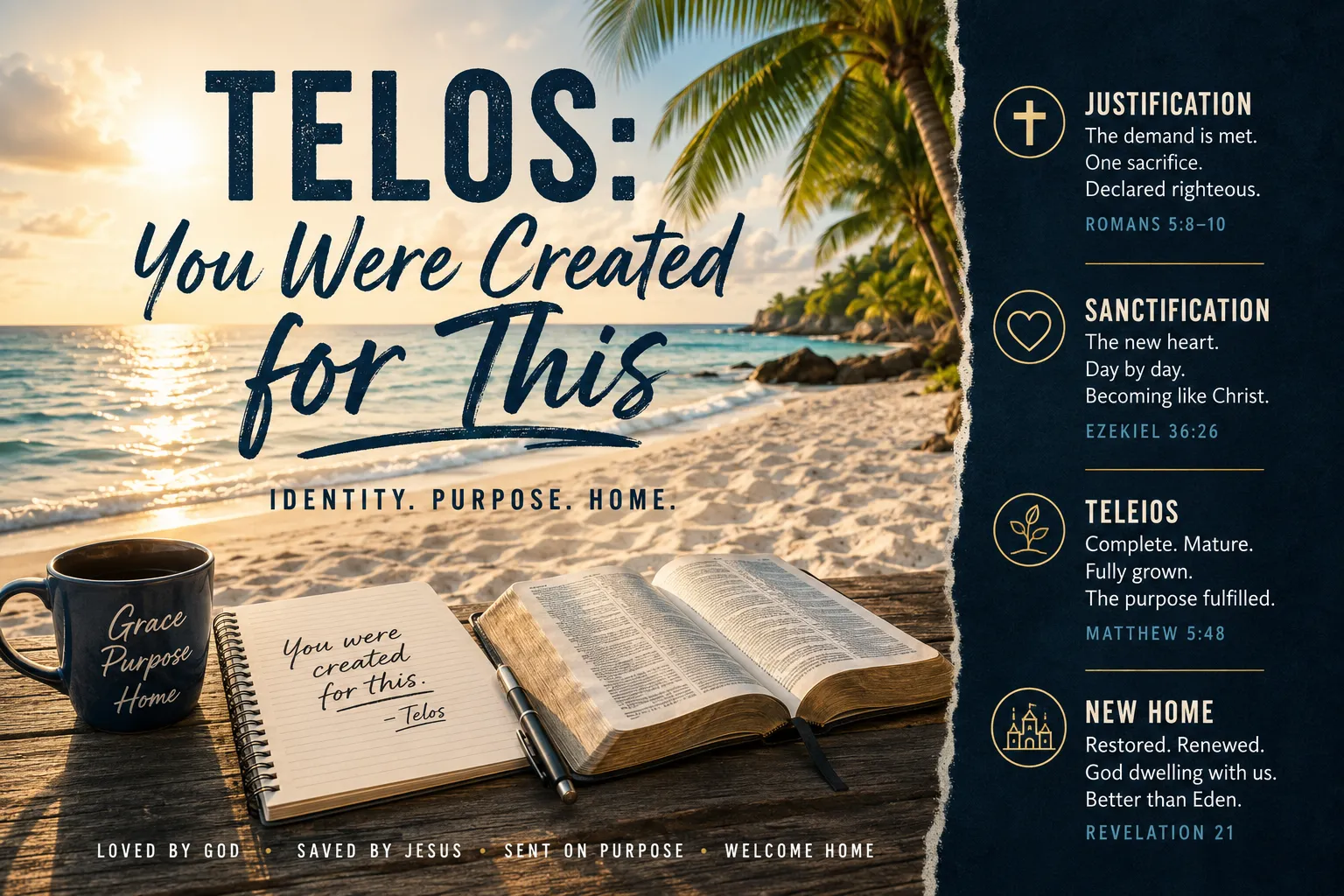
Image source: ChatGPT
The sun reflected off the waves. The sand looked like baby powder. Another near-perfect 83-degree day, with a gentle breeze softening the heat and tall palm trees bent slightly to provide shade.
I took a deep breath of the salty air, closed my eyes, and tried to sleep off the most recent in a long string of hangovers.
I was chasing something. I just wasn’t sure what.
I had moved around a bit, mostly tropical beach destinations, looking for the perfect place. I think I got as close as possible in the Caribbean. And yet, here I was. Hungover. Miserable. From the outside, everything looked fine: dream destination, decent job, plenty of friends, nothing pressing to worry about. From the inside, empty.
Sleep was elusive. My head hurt too badly. The thought finally came: God, seriously? This is my purpose? This is why I’m alive? To endure the endless cycle of hangovers and a life that feels pointless?
Sometimes it seems the more beautiful the geography, the more broken the people. Like they found perfection, only to find it empty.
What came back, not audibly but unmistakably, was something like: Finally, you’ve asked. No. This isn’t the point. Let’s get you home and onto the path I have called you to.
Two weekends later, I moved back home. I started attending church. Through a sermon on Passover, I met Jesus. The path changed.
We often tell the young men in our society to go on adventures to find themselves. To find their identity. To sow their wild oats.
But identity is not something we discover by drifting. Our Heavenly Father has already given us one, along with a purpose and a calling. That’s almost never what we set out to find.
Your transcendent cause is the telos God created you for, fulfilled in becoming like Christ (teleios), expressed as love for God and love for neighbor..
Telos: You Were Created for This
God creates everything with the end in mind. From Genesis to Revelation, He works toward a telos: a purpose and a plan. He formed each of us, knit together in our mother’s womb, known before we drew a breath (Ps 139:13-16).
His original creation was good. Eden was the template of His intent: His image-bearers dwelling with Him in unbroken communion, working, eating, walking with God in a place without sin or fear.
That communion is the deep memory underneath every restless human pursuit.
By Genesis 3, the template was fractured. Sin entered the world and broke everything. It twisted work. It distorted our relationship with God and with each other. It scrambled the purpose He placed in us. Humanity was exiled from the garden into a sin-infected world.
We’ve been searching for what we lost ever since, blind men in a maze.
We chase success and over-invest in work. Some try to escape into a bottle. Others reach for it in relationships. I tried most of these, including the “perfect” destination.
Some of us look in places that seem good. Religion. Morality. Being a good person. We over-index on respectable things and call the result spirituality.
The restlessness underneath the hustle, the relationships, the achievements, is a telos problem, not a circumstance problem.
The Wrong Cause: Pharisee Religion (Matthew 5:17-20)
Western culture bows to performance.
Ask anyone how they’re doing. The almost-guaranteed answer is “busy.” You only worked 60 hours last week? I worked 65. You volunteered two days? I served four.
We have an extraordinary capacity to pervert anything. Even good things. Especially good things. Performance with the wrong heart is the engine.
Jesus rebukes the Pharisees often, but especially in Matthew 23. These were people doing good things. They knew Scripture. They prayed. They gave. They were “God’s people.” Jesus calls them hypocrites anyway.
The motivation was wrong. They were not operating from faithful, heart-driven devotion. They were grand-standing for attention and admiration. They were pursuing self-righteousness instead of God’s.
The Lexham Theological Wordbook defines δικαιοσύνη (dikaiosynē) as “justice, righteousness; the quality of being in accordance with God’s law.” The word carries both a moral sense (living rightly) and a legal sense (being declared right).
Jesus says He did not come to abolish or relax the Law. He says our righteousness must exceed the Pharisees’. That sounds impossible until you understand what He is and is not asking for. He is not asking for more religious performance. He is asking for a different heart.
In Matthew 22:36-40 (ESV), He summarizes the entire Law this way:
“Teacher, which is the great commandment in the Law?” And he said to him, “You shall love the Lord your God with all your heart and with all your soul and with all your mind. This is the great and first commandment. And a second is like it: You shall love your neighbor as yourself. On these two commandments depend all the Law and the Prophets.”
God gave us an identity in His image. He gave us a telos: to glorify Him and love Him, and to extend that love to others. The right cause is not compliance, performance, or religious theater. The right cause is becoming the kind of person who loves like that.
The wrong cause is performing for a verdict that has not been given. The transcendent cause begins where the verdict has already been declared.
Justification: The Demand Is Met
Jesus, the Son of God, existed before creation. He stepped down from His rightful place and entered our world on a rescue mission.
His mission was to complete the Father’s will: that the Father’s children would be redeemed and brought home. God the Father loves us so much that He sent His Son to die so we could be restored as His family (John 3:16).
The wages of sin is death (Rom 6:23), and without the shedding of blood there is no forgiveness (Heb 9:22). The payment is steep, and we cannot make it. We inherited the very sin we cannot pay for.
Through the virgin birth, Jesus stepped past that inheritance and was born without sin. He continued to live the life we could not, perfectly aligned with the Father’s will. He faced real temptation. He never sinned. (I explored this more in the previous post, Don’t Win the Wrong Game.)
Then He fulfilled the Father’s will at the cross. He was wrongly convicted and crucified as a sinner, though He was never one. He took on the sin of the world there. He paid what we could not.
The cosmic court demanded payment. Jesus paid it. By doing so, He declared everyone who trusts Him fully free. One sacrifice. One gift. Full satisfaction. We are declared righteous (dikaioō) in Him.
The Baker Encyclopedia of the Bible (Elwell and Beitzel) defines justification as “the act of God in bringing sinners into a new covenant relationship with himself through the forgiveness of sins… a declarative act of God by which he establishes persons as righteous; that is, in right and true relationship to himself.”
We do not perform, posture, or earn our way to God. Nothing we could do would be enough. The payment has already been made. What remains is to accept the Father’s invitation: come back home, as sons and daughters, through faith in Jesus.
Sanctification: The New Heart (Matthew 5:1-47)
Justification and sanctification are different.
Justification is a one-and-done event. Declared free. Past, present, future. Complete.
Sanctification is an ongoing process. More like a child growing up.
Ezekiel 36:26 (ESV) paints it well:
“And I will give you a new heart, and a new spirit I will put within you. And I will remove the heart of stone from your flesh and give you a heart of flesh.”
God performs a heart transplant. Then He reshapes that new heart, day by day, by His own Spirit.
The Greek hagiazō means being made holy. Sanctification is the journey, not the entry.
Justification gets you in. Sanctification is who you are becoming inside.
Jason Allen’s Matthew sermon series at Life Connection Church keeps returning to the question: who are you becoming? Where do you find your identity?
In the Sermon on the Mount, Jesus walks through a series of heart conditions. These are not goal posts for salvation. They are markers of an ongoing transformation: the new heart of flesh growing into a heart that beats like the Father’s.
Beatitudes (5:3-12): The Root, Not the Performance
Jesus sits down on the mountain. The disciples gather. He begins to teach.
He does not start with rules. He starts at the root. The Beatitudes describe what life looks like at the root level when God has begun reshaping a person.
He is showing what His scoreboard looks like compared to the world’s. He cares more about the hearts of His people than their performance.
Salt and Light (5:13-16): Indicative, Not Imperative
You’ve probably met people who follow Jesus and just seem different. Joyful or radiant even in situations where others would not be.
That’s because they are. As Christians, we have been set free. No longer under the guilt of sin. No longer captive to the world. We should live like it.
Set apart. Holy. Different. Not in an “I’m better than you” way. Not in a religious, uppity way. In the way that prisoners who have been eternally freed cannot help but live.
We have the best news ever. We should live as if it’s true.
The Six Antitheses (5:21-47): To the Root
Notice Jesus doesn’t abolish the Law. He doesn’t even relax it. He reveals its true heart-intent.
The pattern: “You have heard it said… but I say to you…”
He is not removing the original command. He is showing that the command was always pointed at the heart, not just the behavior.
Anger (5:21-26): Murder begins in the heart. Jesus addresses murder, then shows that taking a life begins as anger long before the act.
Lust (5:27-30): Adultery begins in the heart. Adultery starts before the first touch. Glances turn to thoughts. Thoughts settle in.
Covenant faithfulness (5:31-32): Divorce begins in the heart. Unhealed hurts harden into bitterness. Without grace, forgiveness, and reconciliation, the heart prepares the way long before the paperwork.
Truthful integrity (5:33-37): Lying begins in the heart. The impulse to slide by, to avoid responsibility, to manage perception is the immature heart-reaction Jesus is targeting.
Non-retaliation (5:38-42): Vengeance begins in the heart. Plenty of practice opportunities here. Someone cuts me off in traffic and my first instinct is rarely grace. The instinct itself is the diagnostic.
Love of enemies (5:43-47): Hatred begins in the heart. Jesus loved us while we were still enemies (Rom 5:10). His mercy overcame our hatred. The same mercy should flow through us toward people we are tempted to hate.
Jesus pruned the religious. He rebuked the performers, the hypocrites, those who thought well of themselves. He transplanted sinners into Himself. He justified them. And He continues to mature them.
He is not merely teaching people how to behave. He is showing what a human life looks like when God becomes its center, the heart becomes its workshop, love becomes its pattern, and obedience becomes its foundation.
Teleios: The Completeness You Are Heading Toward (Matthew 5:48)
The call is perfection. Jesus says so directly in Matthew 5:48 (ESV):
“You therefore must be perfect, as your heavenly Father is perfect.”
Honestly, this was probably the most clarifying verse in the chapter for me. I have read it many times and, candidly, I think I have skipped over it more than once. Perfection is not achievable, so my mind moved on.
On one hand, I was right. I cannot achieve perfection. That is exactly why Jesus came. He lived the perfect life I could not, on my behalf.
On the other hand, I was misreading the verse. The Greek word here is teleios. It does not mean “without error” the way our English “perfect” does. It means complete, mature, fully grown.
Connect it to telos, our purpose, and the meaning lands: we are matured into the purpose for which we were made.
Just as biological children grow up, God spiritually grows us up through sanctification.
God created us with a purpose (telos) and works in us by the Holy Spirit to bring that purpose to fruition (teleios).
He does not demand that we achieve perfection on our own. He knows we cannot. As Jesus tells the disciples in Matthew 19:26 (ESV): “With man this is impossible, but with God all things are possible.”
New Home: Where the Cause Resolves (Revelation 21)
Go back to the beginning, to Genesis. There you find the root of the longing.
The world was good. People were very good. There was no sin. No pain. There was work, food, abundance. The people walked with God. They were in His presence, unafraid.
This was the telos for which we were created: to walk in the goodness of God and to glorify Him.
In Genesis 3, the desire for more overtook humanity. Sin entered. Everything fractured. We were separated from a Holy God who cannot abide sin.
But John 3:16 tells us God loved us so much that Jesus came on a rescue mission. He redeemed. He paid the ransom. He restored us to the Father. He lived the perfect life we could not. He became the perfect sacrifice. He died for us, making propitiation we could not afford, justifying us and freeing us from sin.
Justification was one-and-done: an eternal declaration of freedom through faith. But God was not done. He loves you as you are, and He loves you too much to leave you that way.
So He continues His work of sanctification. Heart transformation. Conforming us into the image of His Son.
Philippians 1:6 (ESV) tells us we can trust that work:
“And I am sure of this, that he who began a good work in you will bring it to completion at the day of Jesus Christ.”
The Spirit will finish what He started. He will make us complete in Christ (teleios).
And then, at the end of the journey, the destination is not a return to Eden. Eden was the template. The destination is greater: the New Creation described in Revelation 21. A city, not a garden. God dwelling with humanity restored, surpassing what Adam and Eve walked away from. The Edenic communion fulfilled in cosmic scale.
The longing was never really for the past. It was for the consummation Eden pointed toward.
Closing: Your Transcendent Cause
When I first heard “transcendent cause,” I assumed it belonged to people who change the world through extraordinary achievements. That may be true sometimes. But it is not the whole picture.
One of my favorite lines, often attributed to Brandi Snyder:
To the world you may be just one person, but to one person you may be the world.
God created you for a purpose: your telos. He did not create you to be good enough. He did not create you to follow the letter of the law morally. He did not create you to accumulate points on the world’s scoreboard.
Your transcendent cause may not be to cure a disease or build a rocket or solve world hunger. It is still your transcendent cause, your telos, what God has called you to. It may shape the life of one person or many. It matters either way.
What is required is ordinary faithfulness. Walking with God. Driven by love. Love that originates in the Father, is reflected back to Him, and then flows through us to others.
This is the path of teleios: becoming what we were made to be, complete as our Heavenly Father is complete.
Years ago in the Caribbean, the question I finally asked was: God, is this my purpose? The answer I heard, in the quiet way He answers, was no.
The home you have been chasing is the home God is welcoming you forward into, through the finished work of Jesus.
Welcome home.
About the Author: Chad is an ordinary dude loved by God, saved by Jesus, and trying to live a faithful life. A blessed husband and dad.
Comments
No comments yet. Yours can be the first.
Comments are read before they appear, so yours will not show up right away.