Transcendent Cause

Image source: ChatGPT

The sun reflected off the waves. The sand looked like baby powder. Another near-perfect 83-degree day, with a gentle breeze softening the heat and tall palm trees bent slightly to provide shade.

I took a deep breath of the salty air, closed my eyes, and tried to sleep off the most recent in a long string of hangovers.

I was chasing something. I just wasn't sure what.

I had moved around a bit, mostly tropical beach destinations, looking for the perfect place. I think I got as close as possible in the Caribbean. And yet, here I was. Hungover. Miserable. From the outside, everything looked fine: dream destination, decent job, plenty of friends, nothing pressing to worry about. From the inside, empty.

Sleep was elusive. My head hurt too badly. The thought finally came: God, seriously? This is my purpose? This is why I'm alive? To endure the endless cycle of hangovers and a life that feels pointless?

Sometimes it seems the more beautiful the geography, the more broken the people. Like they found perfection, only to find it empty.

What came back, not audibly but unmistakably, was something like: Finally, you've asked. No. This isn't the point. Let's get you home and onto the path I have called you to.

Two weekends later, I moved back home. I started attending church. Through a sermon on Passover, I met Jesus. The path changed.

We often tell the young men in our society to go on adventures to find themselves. To find their identity. To sow their wild oats.

But identity is not something we discover by drifting. Our Heavenly Father has already given us one, along with a purpose and a calling. That's almost never what we set out to find.

Your transcendent cause is the telos God created you for, fulfilled in becoming like Christ (teleios), expressed as love for God and love for neighbor..

Telos: You Were Created for This

God creates everything with the end in mind. From Genesis to Revelation, He works toward a telos: a purpose and a plan. He formed each of us, knit together in our mother's womb, known before we drew a breath (Ps 139:13-16).

His original creation was good. Eden was the template of His intent: His image-bearers dwelling with Him in unbroken communion, working, eating, walking with God in a place without sin or fear.

That communion is the deep memory underneath every restless human pursuit.

By Genesis 3, the template was fractured. Sin entered the world and broke everything. It twisted work. It distorted our relationship with God and with each other. It scrambled the purpose He placed in us. Humanity was exiled from the garden into a sin-infected world.

We've been searching for what we lost ever since, blind men in a maze.

We chase success and over-invest in work. Some try to escape into a bottle. Others reach for it in relationships. I tried most of these, including the "perfect" destination.

Some of us look in places that seem good. Religion. Morality. Being a good person. We over-index on respectable things and call the result spirituality.

The restlessness underneath the hustle, the relationships, the achievements, is a telos problem, not a circumstance problem.

The Wrong Cause: Pharisee Religion (Matthew 5:17-20)

Western culture bows to performance.

Ask anyone how they're doing. The almost-guaranteed answer is "busy." You only worked 60 hours last week? I worked 65. You volunteered two days? I served four.

We have an extraordinary capacity to pervert anything. Even good things. Especially good things. Performance with the wrong heart is the engine.

Jesus rebukes the Pharisees often, but especially in Matthew 23. These were people doing good things. They knew Scripture. They prayed. They gave. They were "God's people." Jesus calls them hypocrites anyway.

The motivation was wrong. They were not operating from faithful, heart-driven devotion. They were grand-standing for attention and admiration. They were pursuing self-righteousness instead of God's.

The Lexham Theological Wordbook defines δικαιοσύνη (dikaiosynē) as "justice, righteousness; the quality of being in accordance with God's law." The word carries both a moral sense (living rightly) and a legal sense (being declared right).

Jesus says He did not come to abolish or relax the Law. He says our righteousness must exceed the Pharisees'. That sounds impossible until you understand what He is and is not asking for. He is not asking for more religious performance. He is asking for a different heart.

In Matthew 22:36-40 (ESV), He summarizes the entire Law this way:

"Teacher, which is the great commandment in the Law?" And he said to him, "You shall love the Lord your God with all your heart and with all your soul and with all your mind. This is the great and first commandment. And a second is like it: You shall love your neighbor as yourself. On these two commandments depend all the Law and the Prophets."

God gave us an identity in His image. He gave us a telos: to glorify Him and love Him, and to extend that love to others. The right cause is not compliance, performance, or religious theater. The right cause is becoming the kind of person who loves like that.

The wrong cause is performing for a verdict that has not been given. The transcendent cause begins where the verdict has already been declared.

Justification: The Demand Is Met

Jesus, the Son of God, existed before creation. He stepped down from His rightful place and entered our world on a rescue mission.

His mission was to complete the Father's will: that the Father's children would be redeemed and brought home. God the Father loves us so much that He sent His Son to die so we could be restored as His family (John 3:16).

The wages of sin is death (Rom 6:23), and without the shedding of blood there is no forgiveness (Heb 9:22). The payment is steep, and we cannot make it. We inherited the very sin we cannot pay for.

Through the virgin birth, Jesus stepped past that inheritance and was born without sin. He continued to live the life we could not, perfectly aligned with the Father's will. He faced real temptation. He never sinned. (I explored this more in the previous post, Don't Win the Wrong Game.)

Then He fulfilled the Father's will at the cross. He was wrongly convicted and crucified as a sinner, though He was never one. He took on the sin of the world there. He paid what we could not.

The cosmic court demanded payment. Jesus paid it. By doing so, He declared everyone who trusts Him fully free. One sacrifice. One gift. Full satisfaction. We are declared righteous (dikaioō) in Him.

The Baker Encyclopedia of the Bible (Elwell and Beitzel) defines justification as "the act of God in bringing sinners into a new covenant relationship with himself through the forgiveness of sins... a declarative act of God by which he establishes persons as righteous; that is, in right and true relationship to himself."

We do not perform, posture, or earn our way to God. Nothing we could do would be enough. The payment has already been made. What remains is to accept the Father's invitation: come back home, as sons and daughters, through faith in Jesus.

Sanctification: The New Heart (Matthew 5:1-47)

Justification and sanctification are different.

Justification is a one-and-done event. Declared free. Past, present, future. Complete.

Sanctification is an ongoing process. More like a child growing up.

Ezekiel 36:26 (ESV) paints it well:

"And I will give you a new heart, and a new spirit I will put within you. And I will remove the heart of stone from your flesh and give you a heart of flesh."

God performs a heart transplant. Then He reshapes that new heart, day by day, by His own Spirit.

The Greek hagiazō means being made holy. Sanctification is the journey, not the entry.

Justification gets you in. Sanctification is who you are becoming inside.

Jason Allen's Matthew sermon series at Life Connection Church keeps returning to the question: who are you becoming? Where do you find your identity?

In the Sermon on the Mount, Jesus walks through a series of heart conditions. These are not goal posts for salvation. They are markers of an ongoing transformation: the new heart of flesh growing into a heart that beats like the Father's.

Beatitudes (5:3-12): The Root, Not the Performance

Jesus sits down on the mountain. The disciples gather. He begins to teach.

He does not start with rules. He starts at the root. The Beatitudes describe what life looks like at the root level when God has begun reshaping a person.

He is showing what His scoreboard looks like compared to the world's. He cares more about the hearts of His people than their performance.

Salt and Light (5:13-16): Indicative, Not Imperative

You've probably met people who follow Jesus and just seem different. Joyful or radiant even in situations where others would not be.

That's because they are. As Christians, we have been set free. No longer under the guilt of sin. No longer captive to the world. We should live like it.

Set apart. Holy. Different. Not in an "I'm better than you" way. Not in a religious, uppity way. In the way that prisoners who have been eternally freed cannot help but live.

We have the best news ever. We should live as if it's true.

The Six Antitheses (5:21-47): To the Root

Notice Jesus doesn't abolish the Law. He doesn't even relax it. He reveals its true heart-intent.

The pattern: "You have heard it said... but I say to you..."

He is not removing the original command. He is showing that the command was always pointed at the heart, not just the behavior.

Anger (5:21-26): Murder begins in the heart. Jesus addresses murder, then shows that taking a life begins as anger long before the act.

Lust (5:27-30): Adultery begins in the heart. Adultery starts before the first touch. Glances turn to thoughts. Thoughts settle in.

Covenant faithfulness (5:31-32): Divorce begins in the heart. Unhealed hurts harden into bitterness. Without grace, forgiveness, and reconciliation, the heart prepares the way long before the paperwork.

Truthful integrity (5:33-37): Lying begins in the heart. The impulse to slide by, to avoid responsibility, to manage perception is the immature heart-reaction Jesus is targeting.

Non-retaliation (5:38-42): Vengeance begins in the heart. Plenty of practice opportunities here. Someone cuts me off in traffic and my first instinct is rarely grace. The instinct itself is the diagnostic.

Love of enemies (5:43-47): Hatred begins in the heart. Jesus loved us while we were still enemies (Rom 5:10). His mercy overcame our hatred. The same mercy should flow through us toward people we are tempted to hate.

Jesus pruned the religious. He rebuked the performers, the hypocrites, those who thought well of themselves. He transplanted sinners into Himself. He justified them. And He continues to mature them.

He is not merely teaching people how to behave. He is showing what a human life looks like when God becomes its center, the heart becomes its workshop, love becomes its pattern, and obedience becomes its foundation.

Teleios: The Completeness You Are Heading Toward (Matthew 5:48)

The call is perfection. Jesus says so directly in Matthew 5:48 (ESV):

"You therefore must be perfect, as your heavenly Father is perfect."

Honestly, this was probably the most clarifying verse in the chapter for me. I have read it many times and, candidly, I think I have skipped over it more than once. Perfection is not achievable, so my mind moved on.

On one hand, I was right. I cannot achieve perfection. That is exactly why Jesus came. He lived the perfect life I could not, on my behalf.

On the other hand, I was misreading the verse. The Greek word here is teleios. It does not mean "without error" the way our English "perfect" does. It means complete, mature, fully grown.

Connect it to telos, our purpose, and the meaning lands: we are matured into the purpose for which we were made.

Just as biological children grow up, God spiritually grows us up through sanctification.

God created us with a purpose (telos) and works in us by the Holy Spirit to bring that purpose to fruition (teleios).

He does not demand that we achieve perfection on our own. He knows we cannot. As Jesus tells the disciples in Matthew 19:26 (ESV): "With man this is impossible, but with God all things are possible."

New Home: Where the Cause Resolves (Revelation 21)

Go back to the beginning, to Genesis. There you find the root of the longing.

The world was good. People were very good. There was no sin. No pain. There was work, food, abundance. The people walked with God. They were in His presence, unafraid.

This was the telos for which we were created: to walk in the goodness of God and to glorify Him.

In Genesis 3, the desire for more overtook humanity. Sin entered. Everything fractured. We were separated from a Holy God who cannot abide sin.

But John 3:16 tells us God loved us so much that Jesus came on a rescue mission. He redeemed. He paid the ransom. He restored us to the Father. He lived the perfect life we could not. He became the perfect sacrifice. He died for us, making propitiation we could not afford, justifying us and freeing us from sin.

Justification was one-and-done: an eternal declaration of freedom through faith. But God was not done. He loves you as you are, and He loves you too much to leave you that way.

So He continues His work of sanctification. Heart transformation. Conforming us into the image of His Son.

Philippians 1:6 (ESV) tells us we can trust that work:

"And I am sure of this, that he who began a good work in you will bring it to completion at the day of Jesus Christ."

The Spirit will finish what He started. He will make us complete in Christ (teleios).

And then, at the end of the journey, the destination is not a return to Eden. Eden was the template. The destination is greater: the New Creation described in Revelation 21. A city, not a garden. God dwelling with humanity restored, surpassing what Adam and Eve walked away from. The Edenic communion fulfilled in cosmic scale.

The longing was never really for the past. It was for the consummation Eden pointed toward.

Closing: Your Transcendent Cause

When I first heard "transcendent cause," I assumed it belonged to people who change the world through extraordinary achievements. That may be true sometimes. But it is not the whole picture.

One of my favorite lines, often attributed to Brandi Snyder:

To the world you may be just one person, but to one person you may be the world.

God created you for a purpose: your telos. He did not create you to be good enough. He did not create you to follow the letter of the law morally. He did not create you to accumulate points on the world's scoreboard.

Your transcendent cause may not be to cure a disease or build a rocket or solve world hunger. It is still your transcendent cause, your telos, what God has called you to. It may shape the life of one person or many. It matters either way.

What is required is ordinary faithfulness. Walking with God. Driven by love. Love that originates in the Father, is reflected back to Him, and then flows through us to others.

This is the path of teleios: becoming what we were made to be, complete as our Heavenly Father is complete.

Years ago in the Caribbean, the question I finally asked was: God, is this my purpose? The answer I heard, in the quiet way He answers, was no.

The home you have been chasing is the home God is welcoming you forward into, through the finished work of Jesus.

Welcome home.


About the Author: Chad is an ordinary dude loved by God, saved by Jesus, and trying to live a faithful life. A blessed husband and dad.

Links to Articles


Don't Win the Wrong Game

Sometimes the most dangerous thing in life isn't chasing the wrong thing. It's chasing a good thing the wrong way.

Men, we tend to be all-consuming and relentless in our pursuit of everything, especially good things.

Work? Good. God created it. Sport? Good. Marriage? God created, 100% good. Your thing? Probably good.

I turned a good thing bad over the weekend.

We went out of town for a baseball tournament. My son pitched one of the best games of his young career. I was proud of him.

Sunday came. Close game, extra innings. Two outs, a couple of runners on. Our pitcher was struggling because the other team's dugout was screaming while he was throwing and he couldn't focus. I needed an out. He had thrown 60 pitches the day before.

Then I did something I swore I'd never do. "Hey son, how's your arm?"

Stupid. I knew the answer before I asked. I knew it wasn't an accurate answer. I knew he'd tell me what I wanted to hear because he wanted the ball.

"It feels amazing!"

We lost the game. I hurt my son. And I violated my values.

This week, studying Matthew 4, I kept running into a better Father leading His Son.

The Holy Spirit Brought Jesus to the Right Game

Matthew 3 ends with Jesus's baptism, which I wrote about in The God Who Got in Line. Immediately after, the Holy Spirit leads Jesus into the wilderness to be tempted by Satan (Matt 4:1–11).

Satan wanted Jesus to win the wrong game. He still does the same with us. He doesn't tempt Jesus to cuss, drink, or break an obvious commandment. He tempts Jesus to operate from His own power instead of trusting the Father.

That's the real battle is not moralism vs. immorality, but self-reliance vs. submission. Satan will happily let you be a "good man" if it keeps you from being a dependent son.

Know Your Playbook

If you want to fight, know your Bible. Most of us guys are ready to go toe-to-toe when we feel wronged. But the real fight isn't physical. The only weapon that works against the ultimate enemy is the Sword of Scripture.

Jesus could have called legions of angels. That wasn't the fight He was there to win. The bigger battle was spiritual, and Jesus fought it with the Word.

Satan tempted Him in three approaches: provision, protection, and power.

Provision. Satan dared Jesus to turn stones into bread. Prove your sonship, feed yourself, act independently of your Father. Jesus answered from Deuteronomy 8:3: "Man shall not live by bread alone, but by every word that comes from the mouth of God." Jesus trusted the Father's timing over His own hunger.

Protection. Satan took Jesus to the pinnacle of the temple and quoted Psalm 91. "He will command His angels concerning you." Jesus answered from Deuteronomy 6:16: "You shall not put the Lord your God to the test." Jesus refused to demand proof of a promise He already believed.

Power. Satan showed Jesus every kingdom of the world and offered them to him. If Jesus would worship him. Jesus answered from Deuteronomy 6:13: "You shall worship the Lord your God and Him only shall you serve." Jesus refused to take the crown without the cross.

Notice what Satan didn't do. He didn't argue about Jesus's identity. The temptations assume it, "since you are the Son of God." The attack wasn't on the title. The attack was on whether Jesus would trust the Father's goodness enough to wait.

It's easy to win the wrong game.

Jesus was fully human. He could feel the pull of hunger, comfort, and a shortcut to a crown. Satan offered Him a fast track: skip the suffering, get the kingdoms now. From the outside, it would have looked like a win. It would have been the wrong win.

He chose obedience over the shortcut. And it cost Him everything.

The Right Roster for the Right Game

After the wilderness, Jesus doesn't go recruit the obvious candidates for the throne He just refused to take early. He moves into the region of Zebulun and Naphtali in Galilee, a mixed-population frontier Isaiah called "Galilee of the Gentiles," and He calls fishermen.

This is still the wrong-game question, just answered on the staffing side. If Jesus had been chasing the world's kingdoms, He'd have built a roster that could take them. He didn't. He picked ordinary dudes.

Not Pharisees. Not the credentialed, polished, or self-righteous. Peter was impulsive and loud. Andrew was a bit quieter. James and John were volatile enough that Jesus nicknamed them Boanerges, "Sons of Thunder" (Mark 3:17), and ambitious enough to ask for thrones later (Matt 20:20–28).

What Jesus does appreciate is the one thing they do right: they drop the nets and go.

Thank God He uses ordinary, broken guys. That means I'm available for His roster.

When He tells them He'll make them "fishers of men," He's not just working a tradesman's pun. Jeremiah 16:16 has God sending fishermen to gather His people. Ezekiel 47 pictures fishermen on the banks of the healed Dead Sea after the river flows out from the temple. Jesus is plugging these guys into a prophetic tradition of gathering. The first nets cast for Isaiah 9's great light.

The right roster, for the right game.

What Call Are You Making?

I have the honor of coaching 8U and 12U baseball. Kids this age are learning to throw, field, run the bases, and be good teammates. We work on fundamentals. We compete. We enjoy winning. There's nothing wrong with any of that.

But I try to keep the goal bigger than the scoreboard. Values. Leadership. Truth. A picture of what faithful competition looks like. We pray and do Bible studies. Baseball is great. Baseball is not ultimate. No game has an eternal impact by itself.

Kids make errors. They strike out. They drop fly balls. They miss signs. They stay on the team. On God's roster it's more secure than that. He chose us. We're going to sin. He doesn't cut us. Our mistakes are covered by the work of Jesus. Still loved. Still valued. Still called to grow.

So whether I'm reading about Jesus in the wilderness or standing on a baseball field with a lineup card, the same question keeps surfacing: what game am I trying to win? Quick results and easy approval? Or faithfulness to what lasts?

I made a ball call. It wasn't life-ending. My son will heal. There will be more games.

Don't make the wrong eternal call. "Be still, and know that I am God" (Psalm 46:10). Mute the distractions. Sit in silence. Spend time with your Heavenly Father in prayer and Scripture. See what He wants to call you to.

We have plenty of good things to chase and win. Just make sure you don't win the wrong game.

Be careful of chasing the view at the summit, of eyeing the kingdoms and their glory. You can probably win them, but at what cost?

About the Author: Chad is an ordinary dude loved by God, saved by Jesus, and trying to live a faithful life. A blessed husband and dad.

And what more shall I say? For time would fail me to tell of Gideon, Barak, Samson, Jephthah, of David and Samuel and the prophets — who through faith conquered kingdoms, enforced justice, obtained promises... (Hebrews 11:32–34, ESV)

Links to Articles

Related Readwise Source Highlights

Playing the Wrong Game

  • Sahil Bloom, The 5 Types of Wealth — "I wasn't playing the wrong game, I was playing the game wrong."

  • Shane Parrish, Clear Thinking — "he'd been trying to win the wrong game."

Good Things Becoming Idols

  • Knotty by Nature, "My Ears Closed, but Heaven Opened" — "consumed with…good things—things that slowly become idols."

  • Knotty by Nature, "Dig It" — "Satan tempted Jesus with good things… rely on his own strength."

  • Tim Keller, Center Church — "Everyone has to live for something, and if that something is not God…"

  • Jared Wilson, The Pastor's Justification — pursuing a "successful ministry" vision as functional idolatry.

Temptation / Matthew 4 / Spiritual Warfare

  • Paul Miller, A Praying Life — Jesus reenacting the desert journey.

  • Bethke & Tyson, Fighting Shadows — Satan eclipsing God with problems/temptations.

  • Bethke & Tyson, Fighting Shadows — "Fight the right way, in the right war."

  • Charles Spurgeon, The Armor of God and Spiritual Warfare — standing firm, sword of the Spirit.

  • Donald Whitney, Spiritual Disciplines for the Christian Life — Word of God as arsenal for the Spirit.

  • Cody Bobay, Soulcon Challenge — Satan sidetracks men from loving Jesus, wives, and kids.

Distraction, Focus, Values as Guardrails

  • Jon Tyson, "Love God With All Your Mind" — "He doesn't even have to deceive you if all he has to do is distract you."

  • Andy Ellis, "Avoiding Negative Value" — "Values are the trail markers that keep you from going the wrong way."

  • Farnam Street, "Surface Area of Luck" — "daily battle to focus on your ultimate goal, not the quick wins."

Be Still Before God

  • Andrew Murray, Abide in Christ — "In quietness and confidence shall be your strength."

  • Chip Ingram, True Spirituality — "quietness and stillness are required."

  • A.W. Tozer, The Pursuit of God — "Lord, teach me to listen."

Baseball / Coaching Hinge

  • Brian Smith, The Christian Athlete — temptations following a loss (short with son/team).

  • Brian Smith, The Christian Athlete — earthly success vs faithful effort.

The God Who Got in Line

Image Source: Gemini

The King of Kings shows up to his own ministry launch and gets in line behind tax collectors and prostitutes.

I don’t know why, but it always surprises me. 

God has a history of using unlikely people to accomplish his will, something we explored in The Uninfluencers

Jesus continues to show up unexpectedly. 

It is no different when we encounter the scene of his baptism and are introduced to John the Baptist. 

The Unorthodox Baptizer

In the first six verses of chapter 3, we meet John the Baptist.

He is not your usual, polished Sunday preacher and certainly does not bear much resemblance to a Pharisee in appearance. 

John shows up robed in camel hair, chewing on some locusts and honey. I imagine we would describe John with words resembling homeless rather than polished. I wonder how we would respond if John showed up to preach in our churches on Sunday. 

John, the last of the Old Testament style prophets fulfills prophecies (2 Kings 1:8; Isaiah 40:3.) He addresses sin directly and without compromise. I think John would make us highly uncomfortable in our modern church culture, both from his appearance and his approach. 

He confronts all people with different approaches: those who recognize their sin, he welcomes to repent and be baptized. Those who don’t recognize their sin, he challenges them to repent and be baptized. He doesn’t use soft or mitigating language; rather, he comes at them directly, addressing the religious power as snakes. 

Those who are far from God often show up in unexpected ways, as well. I think, more often than not, we imagine evil as someone convulsing with their head spinning 360-degrees around their body, and while possible, more likely manifests in a three-piece suit with a large following.

If we were to have passed John the Baptist and the Pharisees on the street, I wonder which we would have assumed was representing God well? Makes me curious who I am judging today?

The Impressive Trees with Dead Roots

Delightfully robed, with power and importance dripping from the tassels of their adornments, the Pharisees and Sadducees arrive to shut down this rogue homeless man who is encroaching on their religious territory. 

They don’t realize they are infected with the sinful pride of the Older Son in the Prodigal Son parable of Jesus. They have done all the right things, know the Word of God intimately, they kept the law, are morally righteous. And, most importantly in their minds, they are from the blessed line of Abraham (Matt 3:9.)

John doesn’t roll out a red carpet for them and welcome them. He confronts them. Invites them, however unpleasantly, to repentance. He warns them that the One who is to come will separate the chaff from wheat, the righteous from the unrighteous, those who walk with God humbly from those who walk in their own self-righteousness. 

This isn't ancient history. This is every person who's ever substituted religious performance for heart transformation. The axe is at the root, not the branches. You can have impressive foliage, church attendance, theological knowledge, moral track record, and still be dead inside.

The danger isn't being far from God. The danger is being close to God, thinking your closeness earned by something you did. The Pharisees' sin wasn't ignorance, it was entitlement. They were So Close, Yet So Far Away, much like what we saw in the post on chapter 2. 

Notice what John the Baptist calls them to. He doesn’t say to either of the groups, go clean yourselves up, get better, do more, do less, or be anything.

He calls them to repent. To turn around. Stop chasing sin in any direction, whether it could be perceived as morally good or bad. It isn’t about what they do, but about who they are and whose they are. 

God does not follow our human expectations. Which is exactly what happens next.

The King at the Back of the Line 

Jesus shows up to be baptized by John, he doesn’t make a grand entrance. I think most of us would expect a king to show up more in the style of the movie Aladdin, where Aladdin’s arrival into the city, as a pretend prince, with great celebration and big to-do. 

Conversely, the King of Kings arrives quietly and gets in line behind tax collectors, prostitutes, and soldiers. Broken people confessing their sins, going under the water, coming up wet and hopeful.

Even John objects when Jesus says he needs John to baptize him. John objects: "I need to be baptized by you, and do you come to me?" Jesus: "Let it be so now, for thus it is fitting for us to fulfill all righteousness" (3:14-15)

Then heaven cracks open. The Spirit descends like a dove. The Father speaks: 'This is my beloved Son, in whom I am well pleased.' Three persons. One moment. One mission.

Though sinless, Jesus steps into the sinner's place taking on the role meant for the guilty. This is the cross in preview. Before Calvary, there's the Jordan River.

The Authentic Invitation

We live in a culture of self-promotion and platform-building. Jesus' first public act was to step down, not up. The King's ministry begins not with a throne but with a river, not with a crown but with submission.

He steps into that line with sinful, broken, lost people, not the line with the self-righteous, important, religious. 

Later, in Matthew chapter 9, Jesus said, “Those who are well have no need of a physician, but those who are sick.”

And, Paul, in Romans 5, describes our posture when Jesus sacrificed his life for ours, “For while we were still weak, at the right time Christ died for the ungodly. For one will scarcely die for a righteous person—though perhaps for a good person one would dare even to die—but God shows his love for us in that while we were still sinners, Christ died for us.”

God invites us and welcomes us exactly as we are. He is not asking us to get better, get our stuff together, clean up our act before stepping into his presence. 

Matthew shows us the King of Kings who doesn't demand that you climb to Him. He climbs down to where we are and He gets in line behind us.


About the Author: Just a broken, sinful, ordinary dude who is loved by God, saved by Jesus who is trying to live a faithful, obedient life. A blessed husband and dad. 

Links to Articles


So Close, Yet So Far Away

(Image Source: Gemini)

Looking at Easter from the beginning.

Death and opposition stalked Jesus from the moment of his birth. Despite being God, he endured hardship, attack, and opposition, more than any of us will face. Yet what strikes me most in Matthew 2 isn't the opposition itself. It's how differently people responded to his proximity.

It is interesting to note that proximity does not necessarily lead to a proper response. 

I think it is easy for us to assume that by attending church, or being near Christians, or even as it was assumed for quite some time being born in the US, made us Christian. In fact, my littlest the other day asked for confirmation that since we attend church, we are Christian, right? 

We discussed that while church is important for community and the Christian life, it doesn’t make us Christian by default. We must place our faith, hope, and trust in Jesus and accept him as our Lord and Savior to be a Christian. 

This was a great opportunity to discuss the gospel with my son. It was also eye-opening when entering Matthew 2, to notice how various people responded to the proximity of Jesus. 

They Knew the Answer

When Herod heard of Jesus' birth, he was immediately terrified. Not with reverent fear, but with the fear of losing his power. He summoned the chief priests and scribes and demanded answers (Matt 2:1-8).

They responded without hesitation. The Messiah would be born in Bethlehem, according to Scripture (Micah 5:2). They knew Scripture verbatim. 

These were the biblical scholars of their day. They had the prophets committed to memory. They possessed the entire roadmap of Jesus' life, the prophecies, the genealogy we looked at in the last article, literally in their working memory. Consider what they would have known well:                                                                                                                                      

  • Isaiah 7:14: The virgin birth, which Paul later connects to breaking the inheritance of sin through Adam (Romans 5:12-19)

  • Isaiah 9:6-7: Jesus, the child called Mighty God, Prince of Peace. 

  • Isaiah 11:1-10: pointing to the genealogy, that Jesus would be a Branch from Jesse's stump. 

  • Isaiah 53: that Jesus would be the suffering servant. 

Now contrast the Magi. They had also learned of Jesus' birth, but with significantly less information. No Torah memorized. No prophetic library at their fingertips. Yet they prepared gifts, traveled from Persia, and came to worship the King.

Six Miles and Twelve Inches

Herod is not ignorant. He knew who Jesus was. But, he reacted with fear. He was concerned about losing his worldly power. 

Similarly, with scribes and chief priests. They immediately responded to Herod when he asked where the child would be born. They knew exactly where to find Jesus, roughly six miles away from Jerusalem, the Holy City, in Bethlehem. 

They didn’t make the trip.

Don't miss this. The chief priests had all the information, all the head knowledge, all the prophecies memorized, yet their hearts were empty. They demonstrated complete indifference to the advent of the Messiah. They didn't take a few hours to walk down the road and check.

The distance between their heads and their hearts was twelve inches biologically. Spiritually, it was worlds apart.

Their indifference calls to mind Jesus' words to the church at Laodicea (Revelation 3:14-22). He confronts them for being lukewarm. Neither hot nor cold. Indifference doesn't demand a response. Comfort doesn't produce action.

Meanwhile, the Magi, Gentiles and outsiders without all of Scripture memorized, made a journey of hundreds of miles through faith to worship the Messiah.

Notice God's immediate grace to the outsider. From the very beginning, he welcomes those the insiders overlooked.

Proximity doesn't guarantee a proper response. Judas walked with Jesus for three years, heard his teaching firsthand, and still chose betrayal. Herod sat six miles away with a roadmap to the Savior and chose murder. The scribes stood even closer to the truth, it was their profession, and chose nothing at all. 

Sometimes nothing is the most damning response.

The Pattern that Never Stopped

From birth, murder, betrayal, and persecution were constant in Jesus' life. But God's love and protection persisted even more.

n the second half of Matthew 2 (vv. 12-23), God warns Joseph through dreams about Herod and instructs him to flee to Egypt. Matthew sees something profound here: Jesus is reliving Israel's story. Israel went down to Egypt, suffered under a tyrant, and was called out by God. Jesus walks the same path, but where Israel failed in the wilderness, Jesus succeeds (Matthew 4). He endures forty days of Satan's temptation, refutes every attempt with Scripture, and angels come to minister to him (Matt 4:11).

The pattern continued through his entire life. Lost, broken, sinful people trying to defeat the very mission meant to rescue and redeem them.

As we celebrate Easter, it is evident that even death could not claim victory. Jesus, once and for all, defeated Satan, sin, and death on the cross to welcome us back into God's family.

Our Journey

Is there a six mile journey you are failing to take? 

We have more knowledge available to us today than at any point in history. Many of us have a few Bibles in our homes. We have resources, research, more documentation than we could possibly consume attesting to the facts of Jesus’ life, death, and resurrection. 

I remember vividly, the beautiful day when laying on the balcony in St. Thomas, when God called me home. I was running, much like the Prodigal Son (Luke 15:11-32.) Side note: Tim Keller did my favorite teaching on this, check it out.

I was the Youngest Son, running. I'm not sure what I was running to or from. It certainly wasn't toward God. Looking back, I think I was searching, unconsciously, for something like the Garden of Eden. I think most of us are. There's an inherent desire in us to return to God's perfect creation, whether we acknowledge it or not.

Gratefully, God didn't wait for me to figure it out. Much like the Father in Jesus' parable, God, my good, good Father, came running to me, inviting me back into his family through the finished work of his Son, Jesus Christ, my Lord and Savior.

Jesus stepped down from his rightful position in heaven, to come to our world. He lived the perfect, sinless life that I couldn’t possibly achieve. He was persecuted and crucified for my sins, taking my rightful place on the cross for me because of my Heavenly Father’s love for me. He completed his work by defeating the grave, rising on Easter morning to overcome Satan and his plans to steal God’s children. Now, Jesus is sitting at the right hand of God, interceding for us! (Romans 8:34, Hebrews 7:25, Hebrews 9:24, 1 John 2:1, Hebrews 1:3)

The courtroom image of 1 John 2:1 isn't a nervous defendant hoping for a good lawyer. It's a case already decided, Jesus presents his own blood as evidence. The verdict is settled. His advocacy isn't "please forgive them" but "I have paid for them." - Tim Keller 

Don't fail to take the twelve-inch journey. Let the knowledge that your Heavenly Father loves you, that Jesus Christ died to redeem you, travel from your brain and penetrate your heart. Come home to God. Let him embrace you like the Father of the Prodigal Son. He is not idly waiting. He is running toward you.

Happy Easter! 


About the Author: Chad is a broken, sinful, ordinary dude who is loved by God, saved by Jesus who is trying to live a faithful, obedient life. A blessed husband and dad. 

Links to Articles


The Uninfluencers

In a world of “influencers” and curated “realities” where everything is designed to promote self, perfection, or at least the illusion of it, it is almost shocking to read about the Uninfluencers that God used to accomplish his plan.

The New Testament doesn't open with a miracle, a sermon, or a dramatic scene. It opens with a list of names.

Following thousands of years of human brokenness and four hundred years without a prophetic voice in Israel, Matthew shares the family tree that leads to God's Redemptive Plan in Jesus Christ. From the outset, it almost appears like a false start. The names on this list include liars, adulterers, idolaters, and exiles. Matthew doesn't flinch. He leads with it.

This is good news generally. And great news for us specifically.

As we explore a section that most people, including me, usually scan through stumbling over the pronunciation of the names, we find something more honest than anything we'd post about ourselves online. We find historical insight, raw reality, and the kind of hope that only God can provide.

A Broken Road

The reality is every single person God used in history was broken. I remember the first time I read through the Bible, encountering the next man in the story thinking, ok, here is the one that is going to be solid and righteous. I mean, I am reading the Bible after all. Surely, someone is going to be righteous. Inevitably, every single one failed at some point. At least, until I got to Jesus.

It made Romans 3:10-12 (ESV) really standout in my mind:

> as it is written: “None is righteous, no, not one; no one understands; no one seeks for God. All have turned aside; together they have become worthless; no one does good, not even one.” 

Since Genesis 3, when sin entered the world through the forbidden fruit, all people have been affected by sin, separated from the Holy God.

But here's the tension Matthew holds throughout this genealogy: God used broken people, and He also called them to faithfulness. Jacob deceived, but he wrestled with God and was changed. David committed adultery and murder, but his repentance in Psalm 51 remains the most honest prayers ever written. Rahab was a prostitute, but Hebrews 11:31 remembers her for her faith, not her occupation. The brokenness was real. So was the call to holiness. Both are true, and Matthew doesn't let us collapse one into the other.

The gospel opens with a genealogy full of adulterers, prostitutes, deceivers, and murderers. This is not accidental. Jesus didn't come from a clean line. He came into a broken one, on purpose. The Savior of sinners came through the family line of sinners.

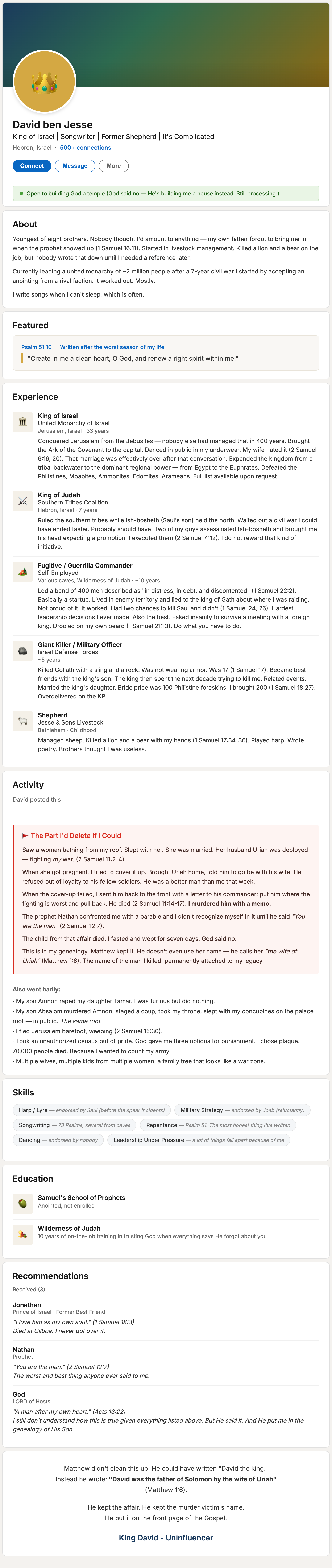
Can you imagine what King David’s unedited LinkedIn profile would look like? 

(Click for full profile)

Four Women Who Shouldn't Be There

Matthew, while communicating to a Jewish audience, calls out four women in the genealogy. This would have been unusual enough on its own for his audience. But these four women carry stories that expose something deeper than scandal.                                                        

Tamar (Matt 1:3) disguised herself as a prostitute to confront her father-in-law Judah, who had broken his covenant promise to provide his son Shelah as a husband. When the truth came out, Judah himself declared, "She is more righteous than I" (Genesis 38:26). Tamar's story isn't about her deception. It's about Judah's failure, and God's purposes advancing through a woman who refused to let a broken promise stay broken.

Rahab (Matt 1:5) was a Canaanite prostitute in Jericho. Her occupation was real. But the writer of Hebrews doesn't remember her for it. "By faith Rahab the prostitute did not perish with those who were disobedient, because she had given a friendly welcome to the spies" (Hebrews 11:31). What defined Rahab was not her past, but her faith.

Ruth (Matt 1:5) was a Moabite, a foreigner from a nation that traced its origin to Lot's incest (Genesis 19). She had no claim on Israel's God or Israel's promises. And yet she clung to Naomi and declared, "Your people shall be my people, and your God my God" (Ruth 1:16). Ruth is faithful, loyal, and an outsider who was grafted in by grace. Her presence in the genealogy quietly says: the Messiah's line was never ethnically exclusive.

Bathsheba (Matt 1:6) is not even named. Matthew calls her "the wife of Uriah," the man David had killed after committing adultery with her. Matthew uses Uriah's name to force the reader to remember David's sin: the affair, the cover-up, and the murder. The indictment falls on David, not Bathsheba. The name of the man David killed is permanently attached to the genealogy of the Son of God. You can read the full story of David's worst failure in 2 Samuel 11.

The Bible Doesn't Read Like a Highlight Reel

The Bible doesn’t read like a modern, perfectly created Instagram post, but more like a journal hidden under a bed, protected by a lock and key. The kind most people would be horrified if another person read. 

It highlights the fact that while God's Creation was originally perfect and sinless, that didn't last long, and we are in desperate need of a Savior.

We all come from a very long line of broken, sinful people. Throughout history, people have tried to obtain righteousness on their own. We can look great on the outside and have broken, sinful hearts. We have pretended to be righteous. Assumed righteousness because of family heritage or moral performance. But we always fall short of the glory of God by our own efforts.

And this is where the genealogy doesn't just comfort the broken. It also confronts the self-righteous. Judah thought he was fine until Tamar exposed him. David thought he had covered his sin until Nathan said, "You are the man" but not in the context that David might have been hoping for. The religious leaders of Jesus' day knew the Scriptures well enough to locate where the Messiah would be born (Matthew 2:4-6) but still plotted to kill Him. Proximity to truth has never guaranteed a right response.

God's Faithfulness, Not Ours

The genealogy is not a record of human faithfulness. It is a record of divine faithfulness despite human failure.

N.T. Wright points out that Matthew's three-by-fourteen structure creates an implicit argument: Israel's story has a pattern. Rise: Abraham to David. Fall: David to the Babylonian exile. And now restoration: exile to Christ. Jesus doesn't just continue the story. He ends the exile. Israel's true return isn't geographic. It's the arrival of the Messiah.

God didn't use broken people because only broken people were available. He designed a redemptive plan that would run through the full range of human failure, so that when it culminated in Jesus, no one could claim the credit belonged to the family line. The mess isn't an obstacle to the plan. It's the terrain the plan was always designed to cross.

Forty-two broken generations. Yet God never broke His promise. Not once.

What Hope Do We Have

Matthew closes Chapter 1 verses 21-25 (ESV) with the introduction of Jesus, who comes from this wild, unlikely family line. 

> She will bear a son, and you shall call his name Jesus, for he will save his people from their sins.” All this took place to fulfill what the Lord had spoken by the prophet: “Behold, the virgin shall conceive and bear a son, and they shall call his name Immanuel” (which means, God with us). When Joseph woke from sleep, he did as the angel of the Lord commanded him: he took his wife, but knew her not until she had given birth to a son. And he called his name Jesus.

The virgin birth isn't a footnote. It's the theological hinge. Every person in the genealogy before this verse inherited the same sinful nature we all have. The line had to be interrupted. Jesus had to be born of a virgin, conceived by the Holy Spirit, because the Redeemer had to be fully human yet free from the corruption that runs through every other branch of this family tree. The genealogy explains why the virgin birth was necessary, and the virgin birth explains how the genealogy's pattern of sin could finally be broken.

Spurgeon put it plainly, "Not merely from the punishment of sin, but from sin itself. It is not said that He will save them in their sins, but from their sins."

If God kept every promise through 42 generations of deeply flawed people, what does that say about your anxiety over whether He'll come through in your situation?

D.A. Carson notes that "God with us" in Matthew 1:23 and "I am with you always" in Matthew 28:20 bookend the entire Gospel. The story that begins with a broken genealogy ends with an unbreakable promise of presence.

I don't know about you, but I often feel "less than" or not worthy to be loved and accepted by God, certainly not used by Him. Like those in the genealogy before me, I have chapters in my story I would rather keep in the locked journal than expose.

This didn't surprise God and didn't catch Him off-guard. He knew every name on that list before they were born. He knew their failures before they committed them. And He put them in the line anyway, not because their sin didn't matter, but because His faithfulness is bigger than our failure.

The really mind-blowing part is that he knew from the beginning. It was his predestined plan for Jesus to enter the world from a line of broken, sinful people then to endure the cross to redeem God’s children. From beginning to end, this was by design.

The Uninfluencer Life

So what does it actually look like to live as an Uninfluencer?

It looks like the man who shows up to lead his family after a hard day at work when no one will write about it. It looks like the woman who mentors a younger mom without posting about it. It looks like confessing sin to a trusted friend instead of performing righteousness for an audience. It looks like ordinary faithfulness in obscurity, which is where most of the Christian life actually happens.

The people in Matthew's genealogy didn't know they were in the genealogy. Rahab didn't know her great-great-grandson would be King David. Ruth didn't know she was three generations from the throne. They were just faithful in the ordinary moment in front of them. That was enough. God handled the rest.

> We live in a time where men are encouraged to build platforms, protect their image, and surround themselves with affirmation. Correction is avoided. Accountability is optional. Truth is filtered.

The Danger of a Self-Made Man, Knotty by Nature

Be faithful where no one sees. Be honest about what's in the locked journal. And trust the God who held every promise through forty-two generations of people who didn't deserve to be in the story.

Neither do we. That's the whole point.

Go be an Uninfluencer. A faithful, ordinary, redeemed child of God.