- Published
- Reading time
- 5 min
- Tags
The God Who Got in Line
The King of Kings shows up to his own ministry launch and gets in line behind tax collectors and prostitutes.
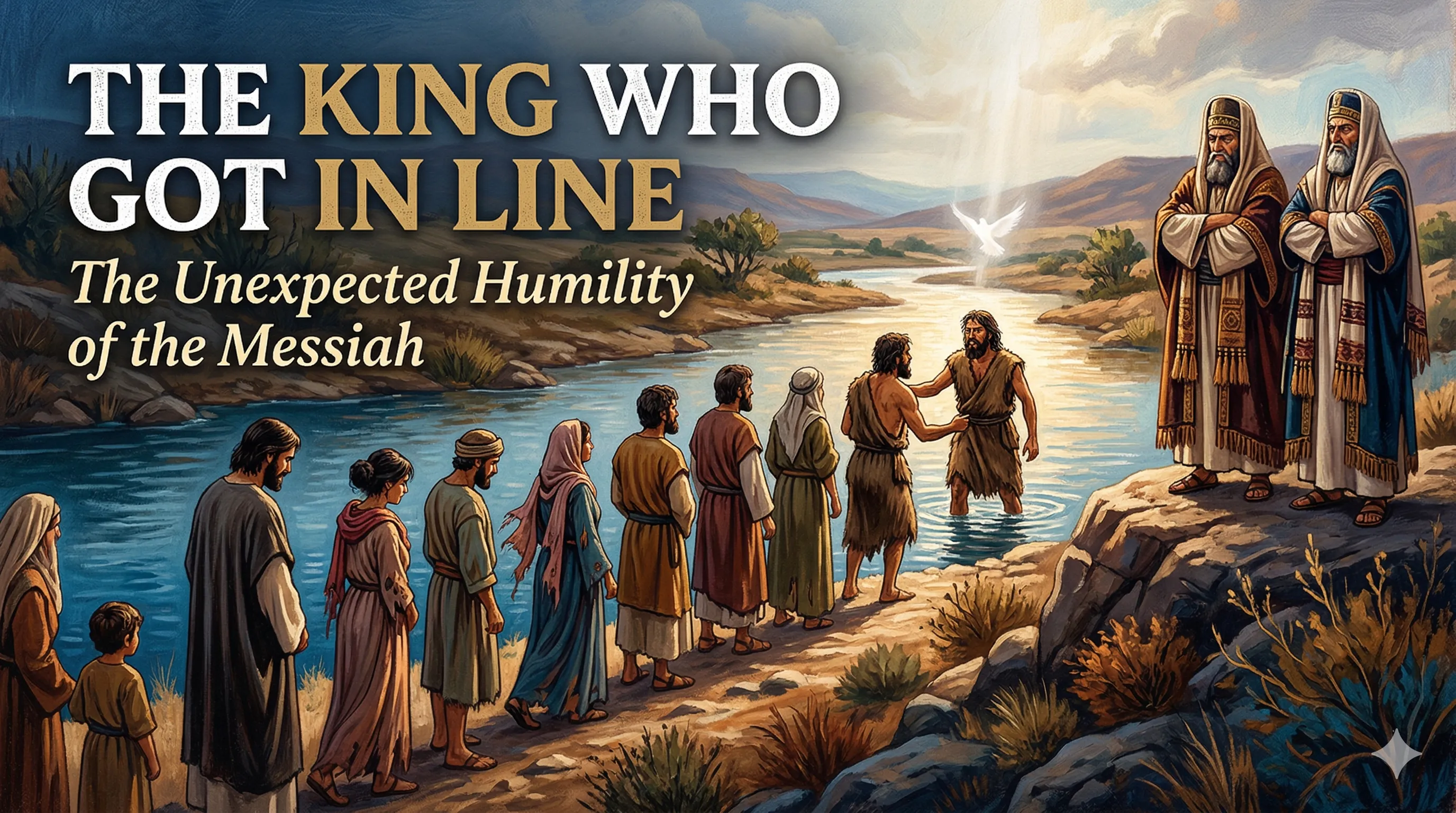
Image Source: Gemini
The King of Kings shows up to his own ministry launch and gets in line behind tax collectors and prostitutes.
I don’t know why, but it always surprises me.
God has a history of using unlikely people to accomplish his will, something we explored in The Uninfluencers.
Jesus continues to show up unexpectedly.
It is no different when we encounter the scene of his baptism and are introduced to John the Baptist.
The Unorthodox Baptizer
In the first six verses of chapter 3, we meet John the Baptist.
He is not your usual, polished Sunday preacher and certainly does not bear much resemblance to a Pharisee in appearance.
John shows up robed in camel hair, chewing on some locusts and honey. I imagine we would describe John with words resembling homeless rather than polished. I wonder how we would respond if John showed up to preach in our churches on Sunday.
John, the last of the Old Testament style prophets fulfills prophecies (2 Kings 1:8; Isaiah 40:3.) He addresses sin directly and without compromise. I think John would make us highly uncomfortable in our modern church culture, both from his appearance and his approach.
He confronts all people with different approaches: those who recognize their sin, he welcomes to repent and be baptized. Those who don’t recognize their sin, he challenges them to repent and be baptized. He doesn’t use soft or mitigating language; rather, he comes at them directly, addressing the religious power as snakes.
Those who are far from God often show up in unexpected ways, as well. I think, more often than not, we imagine evil as someone convulsing with their head spinning 360-degrees around their body, and while possible, more likely manifests in a three-piece suit with a large following.
If we were to have passed John the Baptist and the Pharisees on the street, I wonder which we would have assumed was representing God well? Makes me curious who I am judging today?
The Impressive Trees with Dead Roots
Delightfully robed, with power and importance dripping from the tassels of their adornments, the Pharisees and Sadducees arrive to shut down this rogue homeless man who is encroaching on their religious territory.
They don’t realize they are infected with the sinful pride of the Older Son in the Prodigal Son parable of Jesus. They have done all the right things, know the Word of God intimately, they kept the law, are morally righteous. And, most importantly in their minds, they are from the blessed line of Abraham (Matt 3:9.)
John doesn’t roll out a red carpet for them and welcome them. He confronts them. Invites them, however unpleasantly, to repentance. He warns them that the One who is to come will separate the chaff from wheat, the righteous from the unrighteous, those who walk with God humbly from those who walk in their own self-righteousness.
This isn’t ancient history. This is every person who’s ever substituted religious performance for heart transformation. The axe is at the root, not the branches. You can have impressive foliage, church attendance, theological knowledge, moral track record, and still be dead inside.
The danger isn’t being far from God. The danger is being close to God, thinking your closeness earned by something you did. The Pharisees’ sin wasn’t ignorance, it was entitlement. They were So Close, Yet So Far Away, much like what we saw in the post on chapter 2.
Notice what John the Baptist calls them to. He doesn’t say to either of the groups, go clean yourselves up, get better, do more, do less, or be anything.
He calls them to repent. To turn around. Stop chasing sin in any direction, whether it could be perceived as morally good or bad. It isn’t about what they do, but about who they are and whose they are.
God does not follow our human expectations. Which is exactly what happens next.
The King at the Back of the Line
Jesus shows up to be baptized by John, he doesn’t make a grand entrance. I think most of us would expect a king to show up more in the style of the movie Aladdin, where Aladdin’s arrival into the city, as a pretend prince, with great celebration and big to-do.
Conversely, the King of Kings arrives quietly and gets in line behind tax collectors, prostitutes, and soldiers. Broken people confessing their sins, going under the water, coming up wet and hopeful.
Even John objects when Jesus says he needs John to baptize him. John objects: “I need to be baptized by you, and do you come to me?” Jesus: “Let it be so now, for thus it is fitting for us to fulfill all righteousness” (3:14-15)
Then heaven cracks open. The Spirit descends like a dove. The Father speaks: ‘This is my beloved Son, in whom I am well pleased.’ Three persons. One moment. One mission.
Though sinless, Jesus steps into the sinner’s place taking on the role meant for the guilty. This is the cross in preview. Before Calvary, there’s the Jordan River.
The Authentic Invitation
We live in a culture of self-promotion and platform-building. Jesus’ first public act was to step down, not up. The King’s ministry begins not with a throne but with a river, not with a crown but with submission.
He steps into that line with sinful, broken, lost people, not the line with the self-righteous, important, religious.
Later, in Matthew chapter 9, Jesus said, “Those who are well have no need of a physician, but those who are sick.”
And, Paul, in Romans 5, describes our posture when Jesus sacrificed his life for ours, “For while we were still weak, at the right time Christ died for the ungodly. For one will scarcely die for a righteous person—though perhaps for a good person one would dare even to die—but God shows his love for us in that while we were still sinners, Christ died for us.”
God invites us and welcomes us exactly as we are. He is not asking us to get better, get our stuff together, clean up our act before stepping into his presence.
Matthew shows us the King of Kings who doesn’t demand that you climb to Him. He climbs down to where we are and He gets in line behind us.
About the Author: Just a broken, sinful, ordinary dude who is loved by God, saved by Jesus who is trying to live a faithful, obedient life. A blessed husband and dad.
Comments
No comments yet. Yours can be the first.
Comments are read before they appear, so yours will not show up right away.