- Published
- Reading time
- 8 min
- Tags
The Uninfluencers
In a world of “influencers” and curated “realities” where everything is designed to promote self, perfection, or at least the illusion of it, it is almost shocking to read about…
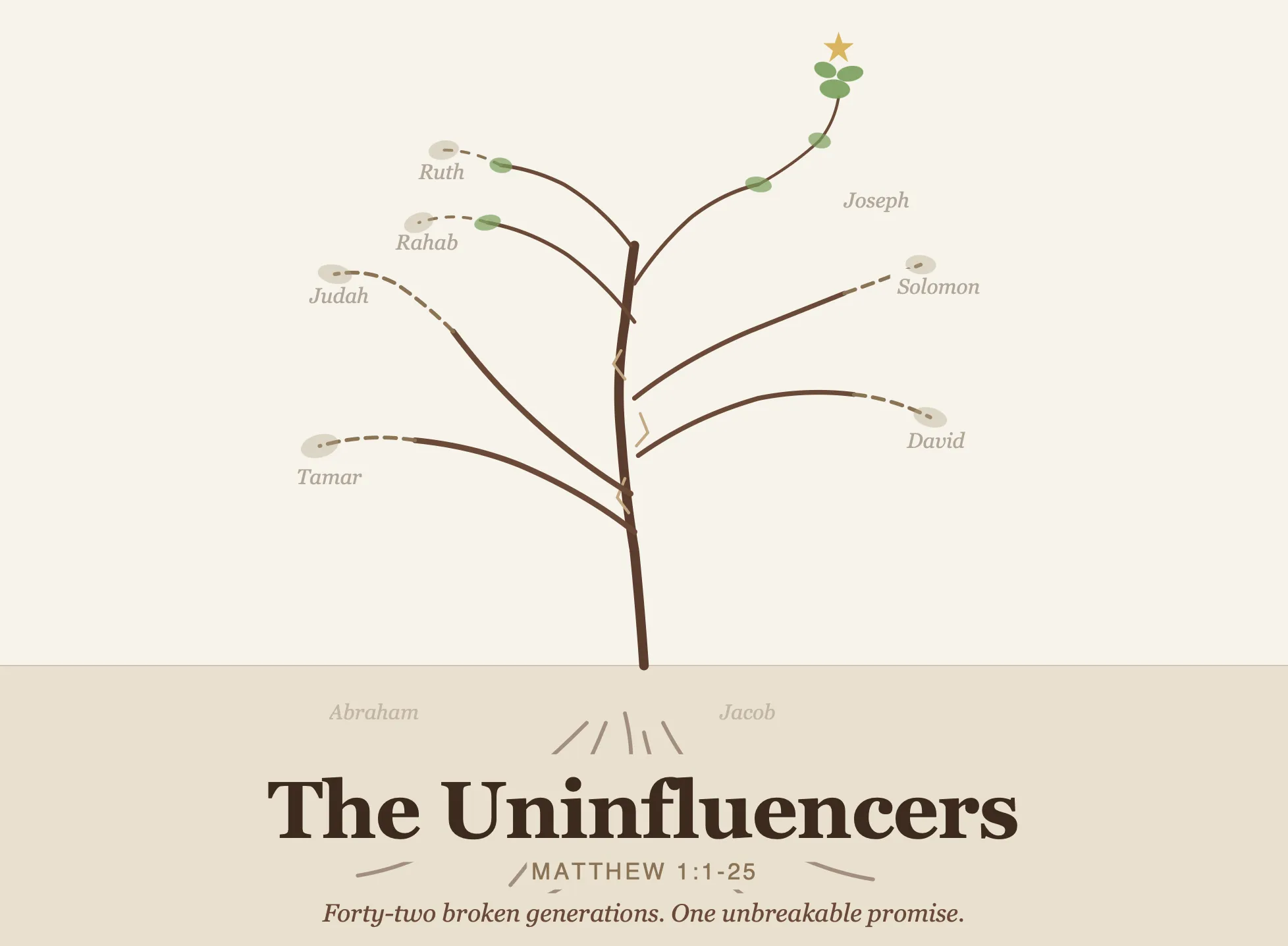
In a world of “influencers” and curated “realities” where everything is designed to promote self, perfection, or at least the illusion of it, it is almost shocking to read about the Uninfluencers that God used to accomplish his plan.
The New Testament doesn’t open with a miracle, a sermon, or a dramatic scene. It opens with a list of names.
Following thousands of years of human brokenness and four hundred years without a prophetic voice in Israel, Matthew shares the family tree that leads to God’s Redemptive Plan in Jesus Christ. From the outset, it almost appears like a false start. The names on this list include liars, adulterers, idolaters, and exiles. Matthew doesn’t flinch. He leads with it.
This is good news generally. And great news for us specifically.
As we explore a section that most people, including me, usually scan through stumbling over the pronunciation of the names, we find something more honest than anything we’d post about ourselves online. We find historical insight, raw reality, and the kind of hope that only God can provide.
A Broken Road
The reality is every single person God used in history was broken. I remember the first time I read through the Bible, encountering the next man in the story thinking, ok, here is the one that is going to be solid and righteous. I mean, I am reading the Bible after all. Surely, someone is going to be righteous. Inevitably, every single one failed at some point. At least, until I got to Jesus.
It made Romans 3:10-12 (ESV) really standout in my mind:
as it is written: “None is righteous, no, not one; no one understands; no one seeks for God. All have turned aside; together they have become worthless; no one does good, not even one.”
Since Genesis 3, when sin entered the world through the forbidden fruit, all people have been affected by sin, separated from the Holy God.
But here’s the tension Matthew holds throughout this genealogy: God used broken people, and He also called them to faithfulness. Jacob deceived, but he wrestled with God and was changed. David committed adultery and murder, but his repentance in Psalm 51 remains the most honest prayers ever written. Rahab was a prostitute, but Hebrews 11:31 remembers her for her faith, not her occupation. The brokenness was real. So was the call to holiness. Both are true, and Matthew doesn’t let us collapse one into the other.
The gospel opens with a genealogy full of adulterers, prostitutes, deceivers, and murderers. This is not accidental. Jesus didn’t come from a clean line. He came into a broken one, on purpose. The Savior of sinners came through the family line of sinners.
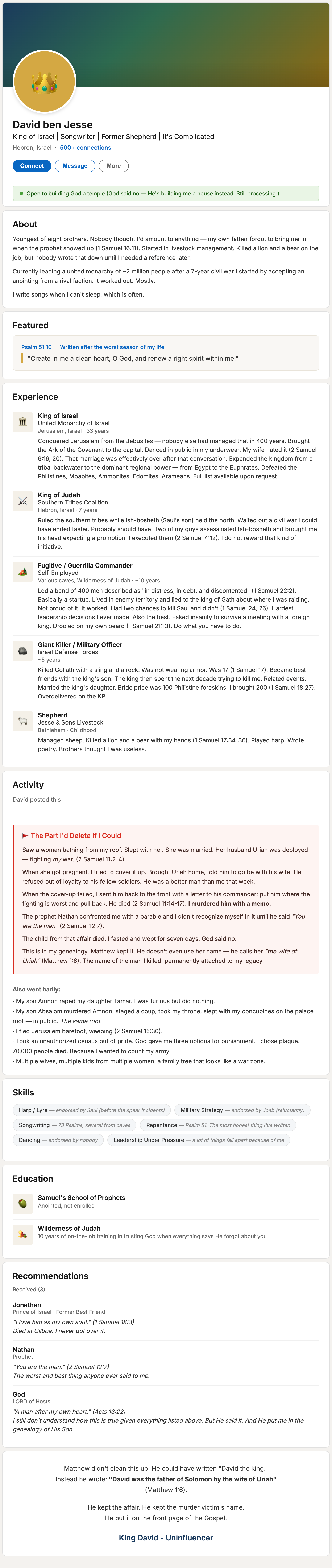
Can you imagine what King David’s unedited LinkedIn profile would look like?

Four Women Who Shouldn’t Be There
Matthew, while communicating to a Jewish audience, calls out four women in the genealogy. This would have been unusual enough on its own for his audience. But these four women carry stories that expose something deeper than scandal.
Tamar (Matt 1:3) disguised herself as a prostitute to confront her father-in-law Judah, who had broken his covenant promise to provide his son Shelah as a husband. When the truth came out, Judah himself declared, “She is more righteous than I” (Genesis 38:26). Tamar’s story isn’t about her deception. It’s about Judah’s failure, and God’s purposes advancing through a woman who refused to let a broken promise stay broken.
Rahab (Matt 1:5) was a Canaanite prostitute in Jericho. Her occupation was real. But the writer of Hebrews doesn’t remember her for it. “By faith Rahab the prostitute did not perish with those who were disobedient, because she had given a friendly welcome to the spies” (Hebrews 11:31). What defined Rahab was not her past, but her faith.
Ruth (Matt 1:5) was a Moabite, a foreigner from a nation that traced its origin to Lot’s incest (Genesis 19). She had no claim on Israel’s God or Israel’s promises. And yet she clung to Naomi and declared, “Your people shall be my people, and your God my God” (Ruth 1:16). Ruth is faithful, loyal, and an outsider who was grafted in by grace. Her presence in the genealogy quietly says: the Messiah’s line was never ethnically exclusive.
Bathsheba (Matt 1:6) is not even named. Matthew calls her “the wife of Uriah,” the man David had killed after committing adultery with her. Matthew uses Uriah’s name to force the reader to remember David’s sin: the affair, the cover-up, and the murder. The indictment falls on David, not Bathsheba. The name of the man David killed is permanently attached to the genealogy of the Son of God. You can read the full story of David’s worst failure in 2 Samuel 11.
The Bible Doesn’t Read Like a Highlight Reel
The Bible doesn’t read like a modern, perfectly created Instagram post, but more like a journal hidden under a bed, protected by a lock and key. The kind most people would be horrified if another person read.
It highlights the fact that while God’s Creation was originally perfect and sinless, that didn’t last long, and we are in desperate need of a Savior.
We all come from a very long line of broken, sinful people. Throughout history, people have tried to obtain righteousness on their own. We can look great on the outside and have broken, sinful hearts. We have pretended to be righteous. Assumed righteousness because of family heritage or moral performance. But we always fall short of the glory of God by our own efforts.
And this is where the genealogy doesn’t just comfort the broken. It also confronts the self-righteous. Judah thought he was fine until Tamar exposed him. David thought he had covered his sin until Nathan said, “You are the man” but not in the context that David might have been hoping for. The religious leaders of Jesus’ day knew the Scriptures well enough to locate where the Messiah would be born (Matthew 2:4-6) but still plotted to kill Him. Proximity to truth has never guaranteed a right response.
God’s Faithfulness, Not Ours
The genealogy is not a record of human faithfulness. It is a record of divine faithfulness despite human failure.
N.T. Wright points out that Matthew’s three-by-fourteen structure creates an implicit argument: Israel’s story has a pattern. Rise: Abraham to David. Fall: David to the Babylonian exile. And now restoration: exile to Christ. Jesus doesn’t just continue the story. He ends the exile. Israel’s true return isn’t geographic. It’s the arrival of the Messiah.
God didn’t use broken people because only broken people were available. He designed a redemptive plan that would run through the full range of human failure, so that when it culminated in Jesus, no one could claim the credit belonged to the family line. The mess isn’t an obstacle to the plan. It’s the terrain the plan was always designed to cross.
Forty-two broken generations. Yet God never broke His promise. Not once.
What Hope Do We Have
Matthew closes Chapter 1 verses 21-25 (ESV) with the introduction of Jesus, who comes from this wild, unlikely family line.
She will bear a son, and you shall call his name Jesus, for he will save his people from their sins.” All this took place to fulfill what the Lord had spoken by the prophet: “Behold, the virgin shall conceive and bear a son, and they shall call his name Immanuel” (which means, God with us). When Joseph woke from sleep, he did as the angel of the Lord commanded him: he took his wife, but knew her not until she had given birth to a son. And he called his name Jesus.
The virgin birth isn’t a footnote. It’s the theological hinge. Every person in the genealogy before this verse inherited the same sinful nature we all have. The line had to be interrupted. Jesus had to be born of a virgin, conceived by the Holy Spirit, because the Redeemer had to be fully human yet free from the corruption that runs through every other branch of this family tree. The genealogy explains why the virgin birth was necessary, and the virgin birth explains how the genealogy’s pattern of sin could finally be broken.
Spurgeon put it plainly, “Not merely from the punishment of sin, but from sin itself. It is not said that He will save them in their sins, but from their sins.”
If God kept every promise through 42 generations of deeply flawed people, what does that say about your anxiety over whether He’ll come through in your situation?
D.A. Carson notes that “God with us” in Matthew 1:23 and “I am with you always” in Matthew 28:20 bookend the entire Gospel. The story that begins with a broken genealogy ends with an unbreakable promise of presence.
I don’t know about you, but I often feel “less than” or not worthy to be loved and accepted by God, certainly not used by Him. Like those in the genealogy before me, I have chapters in my story I would rather keep in the locked journal than expose.
This didn’t surprise God and didn’t catch Him off-guard. He knew every name on that list before they were born. He knew their failures before they committed them. And He put them in the line anyway, not because their sin didn’t matter, but because His faithfulness is bigger than our failure.
The really mind-blowing part is that he knew from the beginning. It was his predestined plan for Jesus to enter the world from a line of broken, sinful people then to endure the cross to redeem God’s children. From beginning to end, this was by design.
The Uninfluencer Life
So what does it actually look like to live as an Uninfluencer?
It looks like the man who shows up to lead his family after a hard day at work when no one will write about it. It looks like the woman who mentors a younger mom without posting about it. It looks like confessing sin to a trusted friend instead of performing righteousness for an audience. It looks like ordinary faithfulness in obscurity, which is where most of the Christian life actually happens.
The people in Matthew’s genealogy didn’t know they were in the genealogy. Rahab didn’t know her great-great-grandson would be King David. Ruth didn’t know she was three generations from the throne. They were just faithful in the ordinary moment in front of them. That was enough. God handled the rest.
We live in a time where men are encouraged to build platforms, protect their image, and surround themselves with affirmation. Correction is avoided. Accountability is optional. Truth is filtered.
– The Danger of a Self-Made Man, Knotty by Nature
Be faithful where no one sees. Be honest about what’s in the locked journal. And trust the God who held every promise through forty-two generations of people who didn’t deserve to be in the story.
Neither do we. That’s the whole point.
Go be an Uninfluencer. A faithful, ordinary, redeemed child of God.
Comments
No comments yet. Yours can be the first.
Comments are read before they appear, so yours will not show up right away.